How to Speak Italian in 5 Minutes: Your First Exchange
Learn how to speak Italian in 5 minutes with a timed café script, clear pronunciation hints, polite phrases, and a simple way to handle the reply.
 The Claryzo Team · · 5 min read
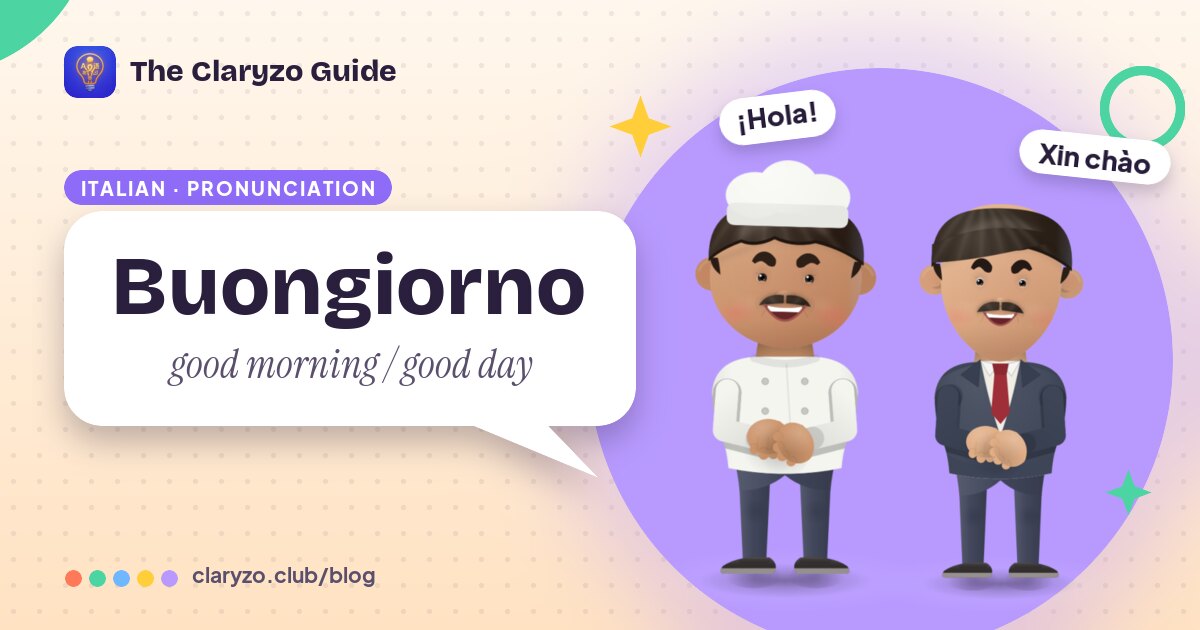
You reach the café counter, recognize half the menu, and suddenly forget every Italian word you have ever met. If you’re searching for how to speak Italian in 5 minutes, here’s the honest answer: five minutes can prepare you for one small exchange. Learn a polite greeting, one request, and a phrase that buys you time when someone answers. Fluency takes longer; ordering a coffee can happen today.
The goal is to say a few useful things clearly and recognize a likely reply. A tiny conversation you can actually finish is worth more than twenty greetings floating around without a job.
How to speak Italian in 5 minutes: the timed version
Set a five-minute timer. Spend the time out loud: reading silently won’t tell you where your mouth gets stuck.
The pronunciation hints below are approximate guides for English speakers. CAPITAL letters mark the stressed syllable. Keep the vowels fairly steady instead of stretching them into English-style glides.
| Time | What to practice | Say it aloud |
|---|---|---|
| 0:00–1:00 | Greet someone politely | Buongiorno (“good morning/good day”), bwohn-JOR-noh |
| 1:00–2:00 | Make one request | Un caffè, per favore (“a coffee, please”), oon kaf-FEH, pehr fah-VOH-reh |
| 2:00–3:00 | Add thanks | Grazie (“thank you”), GRAHT-tsyeh |
| 3:00–4:00 | Prepare for a fast reply | Può ripetere, per favore? (“Could you repeat that, please?”), pwoh ree-PEH-teh-reh, pehr fah-VOH-reh |
| 4:00–5:00 | Rehearse the exchange | Play both customer and barista, then repeat without reading |
During each minute, read the phrase slowly twice, look away, and try it from memory. Check the wording after the attempt. The small struggle to retrieve a phrase is useful practice.
How to speak Italian for beginners
Start with language that has a clear destination: greeting a person, requesting something, or asking for help. Those phrases give your first conversation a manageable shape.
Buongiorno (“good morning/good day”; bwohn-JOR-noh) is a useful polite opening in a daytime shop or café. Ciao (“hi/bye”; chow, rhyming with “now”) is informal. A greeting you use with a friend isn’t automatically the best opening with an unfamiliar adult.
For your first request, the noun plus “please” is enough. You can add vorrei (“I would like”; vor-RAY) when the shorter request feels comfortable. Hold the doubled R briefly if you can, but don’t let an imperfect R stop the sentence.
Keep the first practice session narrow. Choose coffee or water, rather than trying to learn everything you might possibly order. The menu will still be there tomorrow.
How do you pronounce these Italian words?
Clear Italian starts with vowels, stress, and consonant length. An elaborate rolled R can wait.
Give the final vowel its space. In favore (“favor,” used in “please”; fah-VOH-reh), the last syllable is a short, audible “reh.” Avoid swallowing the ending or turning it into “ray.” Keep your tongue toward the front of your mouth and your lips relaxed.
Make doubled consonants last longer. In caffè (“coffee”; kaf-FEH), your upper teeth touch your lower lip for the F. Keep air flowing through that contact slightly longer than for a single F, then release into the stressed final vowel. Don’t insert an extra vowel between the consonants.
Keep the ending of “thank you.” Grazie (“thank you”; GRAHT-tsyeh) has two syllables. After the “ts” sound, move directly into a brief “yeh.” The word doesn’t end at “grahts,” however tempting that shortcut feels.
Italian accents vary by region. These hints aim for broadly understood pronunciation, without pretending that everyone from Milan to Naples sounds alike. The guide to what makes Italian difficult explains why listening and sound distinctions deserve attention beyond the first session.
Your first Italian café conversation
Here’s a short exchange you can copy. Read both roles so the barista’s line doesn’t arrive as a complete surprise.
You: Buongiorno. Un caffè, per favore. (“Good morning. A coffee, please.”; bwohn-JOR-noh. oon kaf-FEH, pehr fah-VOH-reh)
Barista: Un caffè? (“A coffee?”; oon kaf-FEH, with a questioning rise)
You: Sì, grazie. (“Yes, thank you.”; see, GRAHT-tsyeh)
In an Italian café, asking for un caffè (“a coffee”; oon kaf-FEH) normally means an espresso. That small cultural detail helps your request produce the drink you expected.
Give each line a physical cue: face an imaginary barista, make the request, then nod at the confirmation. In Claryzo, the animated cast acts out words and phrases, giving meaning a visible scene before you read a translation. The same principle helps here: connect the request to the coffee arriving.
Once the exchange feels comfortable, change just the drink: Un tè, per favore (“a tea, please”; oon teh, pehr fah-VOH-reh). One substitution lets you practice making a choice inside a familiar sentence.
What if you don’t understand the reply?
Your carefully practiced sentence may receive an answer you haven’t practiced at all. That’s normal conversation doing its mildly inconvenient thing.
Use Può ripetere, per favore? (“Could you repeat that, please?”; pwoh ree-PEH-teh-reh, pehr fah-VOH-reh). This is a polite request addressed to one person. Say the whole phrase steadily; speed adds nothing useful here.
Another useful phrase is Più lentamente, per favore (“More slowly, please”; pyoo len-tah-MEN-teh, pehr fah-VOH-reh). Round your lips for the “oo” in the first word, and keep the final “eh” in the longer word audible.
Practice the recovery phrase as seriously as the order. Being able to ask again gives you a way to stay in the conversation when your listening hasn’t caught up with your rehearsed opening.
How to speak Italian fast after the first five minutes
For useful progress, repeat a small exchange over several days and gradually change its details. The broader daily plan for learning a language by yourself can help turn that small rehearsal into a regular habit.
Use this short protocol for the next practice session:
- Choose one scene. Keep the café exchange until you can recall the lines.
- Say your request from memory. Check the words afterward.
- Practice one likely reply. Switch roles and answer it.
- Add the recovery phrase. Rehearse asking someone to repeat.
- Change one detail. Swap the drink, then repeat the whole exchange.
Five minutes can give you a sentence you’re willing to use. The café counter is a perfectly respectable place to begin.