How to understand native speakers when they talk quickly
Short drills show how to understand native speakers when they talk quickly, from recognizing linked words to following conversations with background noise.
 The Claryzo Team · · 4 min read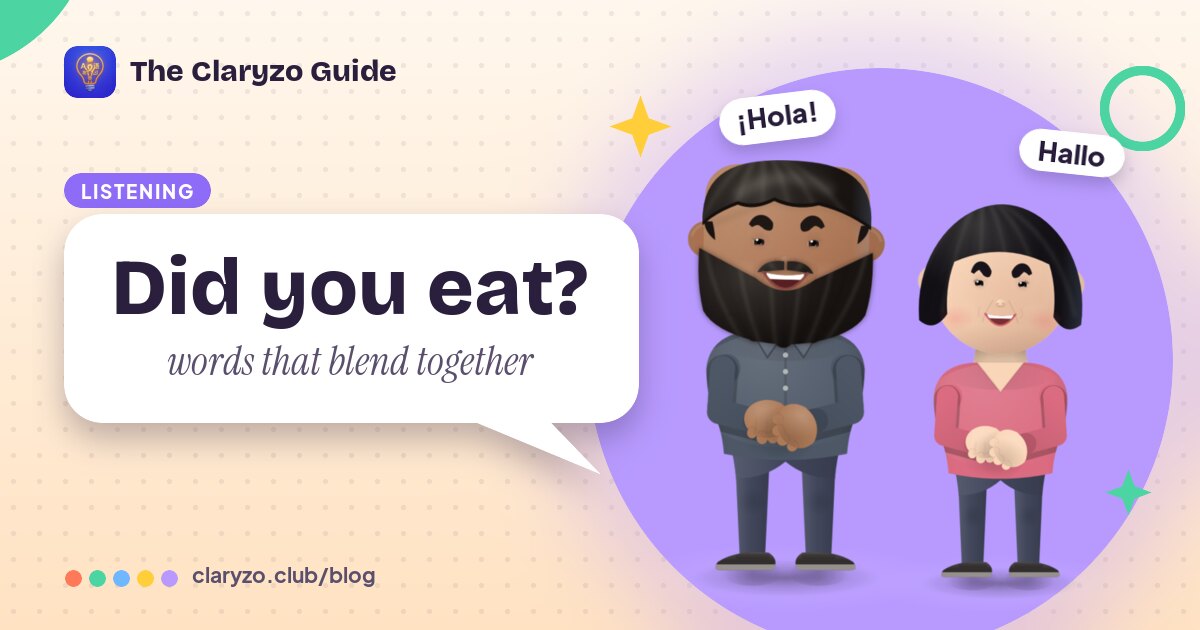
Understanding learner podcasts but losing the thread over lunch is a cue to practice short clips of everyday conversation with an accurate transcript. Learning how to understand native speakers when they talk quickly means recognizing familiar words in their spoken forms, then gradually adding unfamiliar voices, unpredictable replies, and noise.
A podcast host kindly finishes a sentence. Your lunch companion remembers something halfway through, changes direction, and asks you a question while the espresso machine contributes its opinion.
Why can’t I understand people when they talk?
Many learner podcasts give you carefully chosen vocabulary, clear pronunciation, and one speaker at a time. Everyday conversation adds reduced sounds, connected words, interruptions, and references everyone apparently already knows.
Conversation also divides your attention. You are listening, deciding what the speaker means, and preparing an answer. A recording asks less of you.
The gap depends on the situation. Understanding a familiar colleague in a quiet room and following several strangers in a crowded restaurant are different listening tasks. Difficulty with the restaurant does not erase your progress with the colleague.
Familiar words can sound unfamiliar
Knowing a word on paper does not guarantee recognizing it in speech. Everyday pronunciation often differs from the careful version you first learned.
In casual American English, Did you eat? (“Have you eaten?”) may sound roughly like didja eat?. The tongue movements at the boundary between did and you can combine into a “j” sound, while the vowel in you becomes short and relaxed.
Linking can hide boundaries, too. In an apple (“one apple”), the final “n” flows straight into the next vowel. Your ears do not receive the neat spaces printed on the page.
These patterns vary with accent, emphasis, and formality. Recognizing English word stress can also help you identify familiar words when their weaker syllables are less distinct.
Choose recordings that expose one gap at a time
Start with a brief conversational clip about something familiar: ordering lunch, making weekend plans, or describing a commute. Choose audio with an accurate transcript or checked captions. Automatic captions can mishear the very phrase you are trying to learn.
If almost every line contains unknown vocabulary, choose easier material. A useful clip lets you follow the situation while leaving a few phrases stubbornly blurry.
Visible context can help establish meaning. Claryzo’s short interactive stories with the animated cast can provide that situational context before you tackle an unscripted exchange.
Build difficulty gradually. Try another speaker discussing the same topic, then a less predictable exchange. Add background noise once clear conversational speech feels manageable. Changing everything at once makes the source of the difficulty hard to identify.
Let the transcript diagnose the problem
Listen before reading. Otherwise, the transcript may do the recognizing for you.
After an initial attempt, compare what you heard with the written line. An unknown word needs meaning and context. A familiar word that surprised you needs repeated encounters with its spoken form. A sentence you understood only after several replays may need easier surrounding material or a shorter segment.
Replay the missed phrase while reading, then hide the text and listen again. Briefly slowing the recording can help locate a sound boundary; return to normal speed before moving on.
Repeating the phrase aloud can make its joins more noticeable. Keep listening practice central: an accurate imitation is optional.
How to understand native speakers when they talk quickly
Use this short listening protocol with one manageable clip:
- Listen for the situation. Identify who is speaking, what they want, and the general topic. Leave unclear words alone for now.
- Listen again for one missed phrase. Write what you think you heard, including gaps.
- Check the transcript. Find the exact point where the sound stopped matching your expectation: a reduced vowel, linked words, or unfamiliar vocabulary.
- Replay and remove the text. Listen with the transcript, then without it, at the original speed.
- Try a fresh example later. Find a similar exchange from another speaker. Understanding a memorized clip is useful practice; a new clip shows what carries over.
Keep some comfortable listening alongside this focused work. Every recording does not need to become a forensic investigation.
Keep the conversation moving while you learn
During a live exchange, ask for the missing piece. Where are we meeting? (“What is the meeting place?”) gives the speaker a specific problem to solve. A general request to repeat everything may produce the same blur twice.
Confirm details that matter, such as a time or address. For less important gaps, follow the next phrase instead of silently replaying the previous one. If the room is loud, moving closer or somewhere quieter can help immediately.
A missed word is allowed to stay missed. Give the next sentence a chance.