The Best Way to Learn Korean: A Practical Daily Plan
Find the best way to learn Korean language skills with Hangul, clear pronunciation drills, useful sentence patterns, and a daily routine you can repeat.
 The Claryzo Team · · 5 min read
You recognize a line from a Korean drama, but ordering a coffee still sends you searching for subtitles. The best way to learn Korean language skills is to learn Hangul alongside audio, practice useful sentences, and recall those sentences across several days. Add short listening sessions and small conversations from the beginning. A repeatable routine will carry you further than collecting resources you never quite open.
Start with one manageable goal: understand and use a few polite sentences without reading an English translation. Korean becomes less mysterious when the sounds, spelling, and situation arrive together.
What is the best way to learn Korean language skills?
Build a daily loop: hear, understand, read, recall, use. Choose beginner material with clear audio, a transcript, and a situation you can picture. One short exchange offers enough material for a useful session.
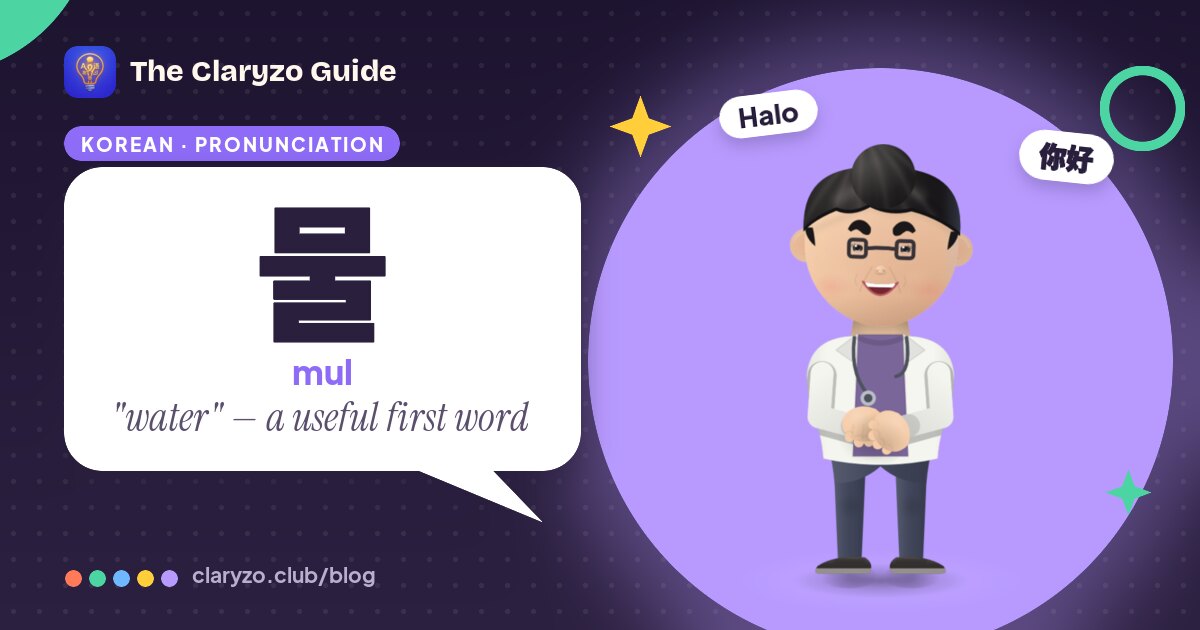
For example, 물 주세요 (mul juseyo, “Water, please”; roughly “mool joo-seh-yoh”) gives you a practical request. Round your lips for the vowel in mul, then let your tongue tip touch the ridge behind your upper teeth for the final consonant. Keep the syllables light; English-style heavy stress can distort the rhythm.
Listen while reading, cover the sentence, then request water from memory. Repeat the request later while holding a glass. That last step connects Korean to an intention, rather than only to English words on a screen.
How to learn Korean alphabet
Learn Hangul early, with recordings beside the letters. Romanization can help you get started, but English spelling is an unreliable guide to Korean sounds.
Hangul letters form syllable blocks. In 물 (mul, “water”; roughly “mool”), three letters fit into one block: an initial consonant, a vowel, and a final consonant. Read the block as one syllable.
Begin with common consonants and vowels, then practice reading familiar words you have already heard. Copy a few blocks by hand if writing helps you notice their parts. Alternate reading with listening so that recognizing a letter also brings a sound to mind.
Recognizing Hangul is an early milestone; reading comfortably takes continued practice. You also need to learn how sounds behave together. A final consonant can sound different when the following syllable begins, so a spelling chart cannot replace recorded words and sentences.
Which Korean sounds should you practice first?
Start with vowels your ears tend to merge, then work on consonant contrasts. Korean distinguishes plain, aspirated, and tense consonants; English categories do not map neatly onto those distinctions.
Consider 불 (bul, “fire”; roughly “bool”) and 풀 (pul, “grass”; roughly “pool” with a stronger puff of air). Both begin with the lips closing and opening. The aspirated consonant in the second word releases more air. Hold a hand near your mouth to notice the difference, while remembering that breath alone does not explain every Korean consonant contrast.
Use a recording that presents both words clearly. Listen, choose which word you heard, then imitate it. Record your attempt and compare one feature at a time: the opening consonant, the vowel, or the ending.
Plain-English hints are starting points. Your target is the Korean recording, not a perfect reading of “bool” or “pool.”
How do you turn vocabulary into usable sentences?
Learn a small sentence pattern and change one part. That gives vocabulary a job immediately.
After the water request, try 커피 주세요 (keopi juseyo, “Coffee, please”; roughly “kuh-pee joo-seh-yoh”). For the first vowel, keep your lips unrounded and open your jaw slightly; the English “uh” is only an approximation. Korean uses a p sound here, so avoid the upper-teeth-on-lower-lip contact of English “f.”
In Claryzo, watching the animated cast act out words and phrases can help connect language with a visible situation before you read a translation. Pair that kind of scene with recall: look away and produce the phrase that fits.
Learn polite endings with your first expressions. The request pattern above is useful in everyday service encounters. Casual language from dramas needs more care because relationships and social setting affect which forms fit.
Add grammar as it answers a real question: how to make a request, describe something, or say what you did. Keep one beginner course as your main sequence so those pieces build on each other.
How to learn Korean fast
Make the practice narrower. A short exchange you understand and can reuse is more useful at the beginning than an hour of dialogue that stays mostly noise.
Use this 20-minute routine:
- Minutes 0–4: Recall yesterday’s phrases before checking your notes.
- Minutes 4–9: Listen to a short beginner exchange. Check the transcript and meaning, then listen again.
- Minutes 9–13: Read two useful sentences aloud with the recording. Focus on one sound.
- Minutes 13–17: Cover the text and use the sentences in a pretend situation.
- Minutes 17–20: Check mistakes and choose what to revisit tomorrow.
Revisit older phrases on later days, too. Retrieval practice helps strengthen memory, and spacing those attempts gives you practice recovering words after a gap.
For listening, alternate transcript-supported work with brief attempts without text. The same principle helps when learning to understand native speakers who talk quickly: identify the words and sound connections you missed, then replay a manageable stretch.
How to learn a language solo
Solo study works better when you create reasons to respond. Point to an object, request something, answer a recorded prompt, or describe a familiar picture. Leave enough silence to retrieve the Korean before revealing the answer.
Once you can produce a few phrases, use them in a brief exchange with a tutor, partner, or patient Korean speaker. Ask for feedback on one sentence or sound. A specific correction is easier to apply than a general verdict on your accent.
The guide to your first real Korean conversation can help you move from isolated requests to an exchange. Measure progress by what you can understand and do without a script; finishing lessons is only one part of learning.
Your first-week checklist
- Practice Hangul with audio each day, using words you understand.
- Choose three polite sentences connected to an ordinary situation.
- Listen, read, and say each sentence; then recall it with the text covered.
- Revisit those sentences on later days and change one element when possible.
- End the week with a short recorded exchange and identify one thing to improve.
Your first useful Korean may arrive while you are thirsty, holding a glass, and finally remembering the words. That is a perfectly respectable beginning.