How to Speak Korean: Easy Words You Can Use Today
Learn how to speak Korean with easy words for greetings, cafés, and travel, plus pronunciation hints and a short routine to help you recall them aloud.
 The Claryzo Team · · 4 min read
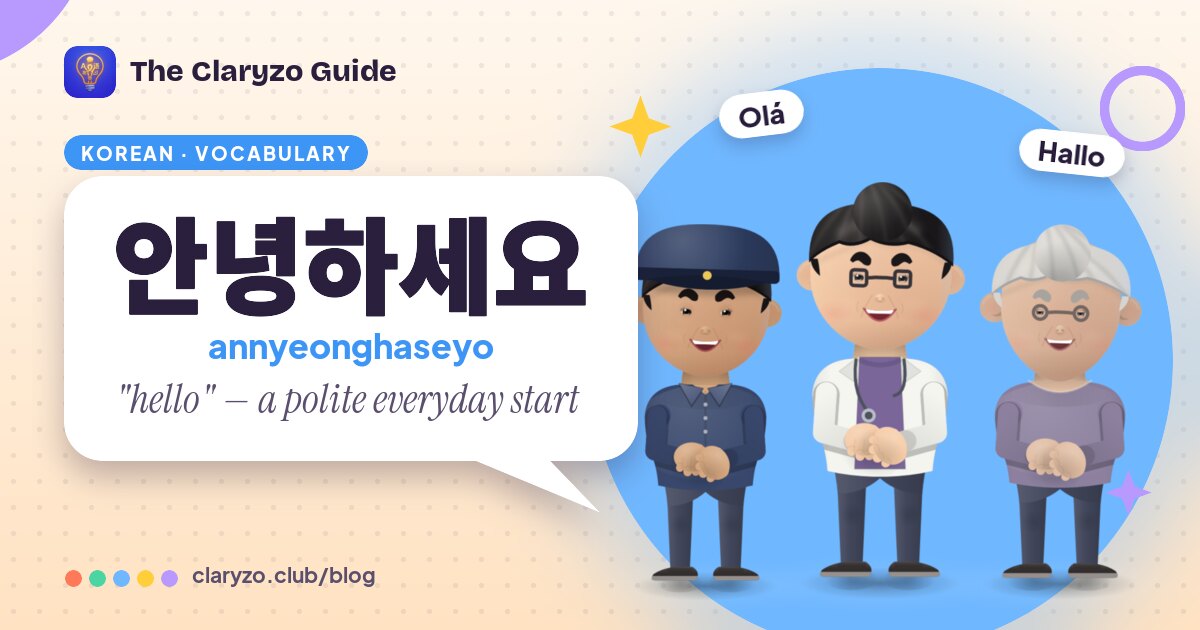
You remember the Korean word for “apple,” then freeze when someone hands you a menu. If you’re searching for “how to speak Korean easy words,” start with polite expressions you can use immediately: a greeting, yes and no, a request, and a thank-you. Learn each expression with its sound and a situation, then practice retrieving it without looking.
The English pronunciation hints below are approximations. Read them once, then listen to Korean audio: English spelling cannot capture every Korean vowel or consonant, and romanization is a temporary aid.
How to speak Korean for beginners
-
Start with a greeting you can use with strangers.
안녕하세요 (annyeonghaseyo, “hello”; roughly “ahn-nyawng-hah-seh-yoh”) is a reliable polite greeting for everyday encounters, including entering a small shop or meeting someone. Keep the syllables connected, with your tongue touching just behind your upper teeth for the n sounds. Practice the whole greeting while imagining a person looking up to welcome you; remembering the encounter gives the expression somewhere to belong.
-
Learn “yes” and “no” together, with one small caution.
네 (ne, “yes”; roughly “neh”) and 아니요 (aniyo, “no”; “ah-nee-yoh”) are useful polite responses, with relaxed lips and no exaggerated English-style vowel glides. Practice answering a simple positive question, such as whether you want coffee, while nodding or shaking your head. Korean responses to negative questions do not always map neatly onto English yes and no, so save those exchanges for later.
Which easy Korean words make a request?
-
Make “water” your first useful noun.
물 (mul, “water”; roughly “mool,” with a shorter vowel than English “pool”) is compact enough to practice without juggling several syllables. Round your lips for the vowel, then finish with your tongue touching the ridge behind your upper teeth. Say the word when you pick up a glass, then cover the written word and recall it from the object alone.
-
Learn the request ending as a complete expression.
주세요 (juseyo, “please give me”; roughly “joo-seh-yoh”) turns a suitable noun into a practical request: 물 주세요 (mul juseyo, “water, please”; “mool joo-seh-yoh”). Say the request smoothly, keeping your lips rounded for the first vowel of the ending. The expression works for asking someone to give you something; English “please” has other uses that need different Korean wording.
How do you remember easy Korean words?
-
Attach a second noun to a scene you recognize.
커피 (keopi, “coffee”; roughly “kuh-pee”) gives you another café request: 커피 주세요 (keopi juseyo, “coffee, please”; “kuh-pee joo-seh-yoh”). For the first vowel, keep your lips unrounded; the English “uh” hint is only approximate. Claryzo’s animated cast acts out words and phrases, giving vocabulary a visible situation before translation—a useful fit for remembering an object together with what someone does with it.
-
Retrieve a thank-you when the imaginary drink arrives.
감사합니다 (gamsahamnida, “thank you”; roughly “kahm-sah-hahm-nee-dah”) is a polite expression you can use widely. Close your lips for the m sounds, including the one you hear before “nee,” and keep the final syllable light. Practice the request, pause as though someone is handing you a cup, and produce the thank-you from memory; reading the same line repeatedly gives you less practice finding it yourself.
What are useful Korean words for travel?
-
Learn a location question as one usable chunk.
화장실 어디예요? (hwajangsil eodiyeyo?, “Where is the restroom?”; roughly “hwah-jahng-shil aw-dee-yeh-yoh”) is natural in everyday conversation, with the topic particle omitted. Let a little breath pass through rounded lips for the opening “hw,” and keep the question connected. A spoken answer may still be difficult, so practice recognizing a gesture or direction alongside the question; asking successfully is only half the exchange.
-
Ask the price while pointing to one item.
얼마예요? (eolmayeyo?, “How much is it?”; roughly “awl-mah-yeh-yoh”) is useful when the object is clear from context. Keep your lips unrounded for the opening vowel, and touch your tongue behind your upper teeth for the following l sound. Practice with a menu or price tag, remembering that understanding the answer requires separate work on Korean numbers and prices.
Which polite expressions help when you get stuck?
-
Ask for a moment before panic supplies the vocabulary.
잠시만요 (jamsimanyo, “one moment, please”; roughly “jahm-shee-mahn-yoh”) can help when you need a brief pause or need to get past someone. Close your lips fully for each m, then move straight into the next syllable. Rehearse the expression while reaching for your wallet or checking a map, so a familiar action becomes the cue to remember it.
-
Learn a gentle way to say you’re okay.
괜찮아요 (gwaenchanayo, “it’s okay” or “I’m okay”; roughly “gwen-chah-nah-yoh”) is useful when someone checks whether you are all right. Move quickly through the opening rounded glide, and release a puff of air on “ch.” The expression can also politely decline an offer, so pair it with a small head shake when you mean “no, thank you”; context carries part of the meaning.
How to speak Korean fast
Getting a few expressions ready quickly is realistic; fluent conversation takes broader vocabulary, listening, and repeated use. A practical Korean daily plan can help you build beyond this starter set without collecting words you never retrieve.
Use this short practice sequence:
- Choose three expressions tied to one situation, such as ordering a drink.
- Listen to each expression, then repeat it at a comfortable pace.
- Hide the text and use an object or imagined encounter as your cue.
- Check forgotten sounds against the audio, then try again later.
Your first useful Korean exchange may be a drink order and a thank-you. That is a perfectly respectable amount of Korean to take out for coffee.