How to Talk in Korean: Get Polite Speech Right
Learn how to talk in Korean with polite endings, eight useful examples, clear pronunciation hints, and a short drill for choosing the right speech level.
 The Claryzo Team · · 5 min read
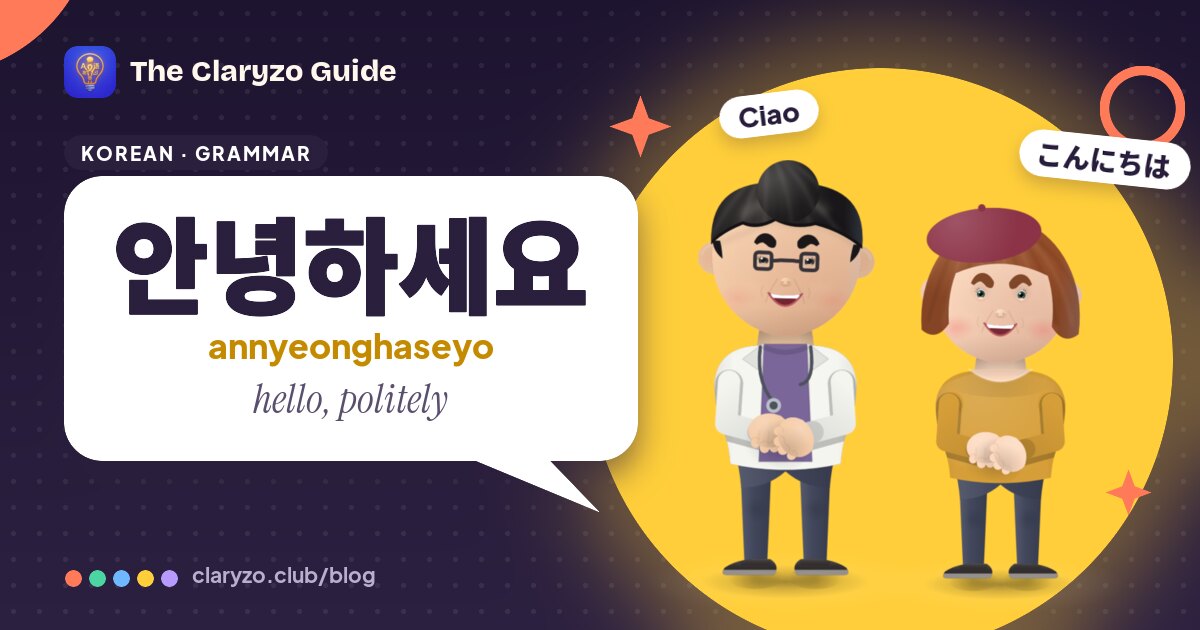
You memorize a Korean greeting, then hear a friend use a shorter version and wonder where half the word went. Learning how to talk in Korean means learning how sentence endings signal your relationship with the listener. Start with everyday polite speech, especially endings with 요 (yo; “yoh”), and you can build useful conversations without sounding unexpectedly familiar.
English speakers already adjust their language for friends, customers, and grandparents. Korean makes some of those choices part of the grammar. The trick is to learn a phrase together with the situation where you would actually say it.
How to talk in Korean without guessing the speech level
Korean has several speech levels, but three broad categories help beginners understand everyday conversations: informal polite, informal casual, and formal polite. These categories describe how speakers address listeners; they do not tell the whole story of Korean respect or social relationships.
Everyday polite speech is a useful starting point when meeting adults, ordering food, or talking to someone you do not know well. Many sentences in this style end with 요 (yo; “yoh”).
Casual speech belongs in relationships where that familiarity is established. Formal polite speech appears in settings such as presentations, announcements, and professional introductions, as well as in some very common expressions.
These styles can appear in the same conversation. A speaker might use a formal expression of thanks and then return to everyday polite sentences. Real conversation is less tidy than a textbook table, which is reassuring once you stop expecting every ending to match.
Why Korean endings trip up English speakers
English often adds politeness through separate words, softer phrasing, and tone. Korean also uses those resources, but a verb ending can carry information that English leaves outside the verb.
Consider these three versions of “I eat” or “I’m eating,” depending on context:
- 먹어요 (meogeoyo) — “I eat / I’m eating,” everyday polite. Roughly “muh-guh-yoh.”
- 먹어 (meogeo) — “I eat / I’m eating,” casual. Roughly “muh-guh.”
- 먹습니다 (meokseumnida) — “I eat / I’m eating,” formal polite. Roughly “muhk-sseum-nee-dah.”
The action stays the same. The relationship with the listener is expressed differently. Korean can leave the subject unstated when context makes the subject clear, so these forms do not inherently contain the word “I.”
For the vowel written eo, open your mouth comfortably and keep your lips unrounded. The “uh” in English “cup” is a rough starting point, although accents differ. For eu, keep your tongue high and your lips unrounded; avoid turning the sound into English “oo.”
Romanization helps you get started, but English spelling cannot capture every Korean sound. Treat the hints as temporary supports alongside recordings.
Eight examples that show the relationship
The three eating examples show the basic contrast. These five expressions bring the total to eight and show why learning complete phrases matters.
| Korean and romanization | Meaning and setting | Plain-English pronunciation hint |
|---|---|---|
| 안녕하세요 (annyeonghaseyo) | “Hello,” a standard polite greeting | “ahn-nyuhng-hah-seh-yoh”; let the final “ng” resonate without adding a hard “g” |
| 안녕 (annyeong) | “Hi” or “bye,” casual | “ahn-nyuhng”; finish on the nasal “ng” |
| 감사합니다 (gamsahamnida) | “Thank you,” formal polite and widely used | “kahm-sah-hahm-nee-dah”; close your lips for the “m” before “nee” |
| 커피 주세요 (keopi juseyo) | “Please give me coffee,” a polite request | “kuh-pee joo-seh-yoh”; round your lips for “joo” |
| 다시 말해 주세요 (dasi malhae juseyo) | “Please say it again,” a polite request | “tah-shee mahl-heh joo-seh-yoh”; use a light tongue contact for the “l” in “mahl” |
The opening consonants represented by g, d, and j do not map perfectly onto English letters. Avoid forcing a heavy English “g” or “d” just because the romanization uses one.
Notice that the standard greeting is more than a casual greeting with a polite syllable attached. Useful expressions have their own established forms. Memorizing the complete expression saves you from assembling something awkward at the counter.
For additional vocabulary to put inside these polite exchanges, the guide to easy Korean words you can use today gives you a natural next layer.
Learn the scene along with the sentence
A phrase becomes easier to choose when you remember who is speaking to whom. Picture meeting a neighbor, thanking a server, or greeting a close friend. The social setting is part of the meaning.
In Claryzo, the animated cast acts out words and phrases, giving you a scene to connect with the language before relying on a translation. That context is useful when studying Korean: alongside the words, pay attention to the relationship you would need to establish in a real exchange.
For your own notes, label each phrase “polite with unfamiliar adults,” “casual with close friends,” or “formal polite.” Those labels are more useful than a page of translations with no clue about when to use them.
Common mistakes with Korean politeness
Do not treat casual speech as the beginner version. A shorter sentence may be easier to pronounce, but familiarity is a social choice. Hearing someone use casual speech toward you does not automatically mean the same style is appropriate in return, especially when age or role differs.
Do not attach the polite ending to every word. Korean politeness is built through grammatical patterns, usually at the end of a clause or sentence. Learn complete, reliable forms before experimenting.
Also separate speech levels from honorifics. Speech levels concern the listener; honorific forms can show respect toward the person being discussed. The systems interact, but adding a polite ending does not solve every respect-related choice.
Finally, avoid assuming formal polite speech expresses greater warmth. A formal ending suits some situations; everyday polite speech suits many friendly exchanges. Appropriate language depends on the relationship and setting.
A five-minute drill for choosing the ending
Practice choosing a social setting before you speak:
- Choose a scene. Imagine a café, a first meeting, or a conversation with an established close friend.
- Choose one complete expression. Use a polite greeting or request for the café and first meeting. Reserve the casual greeting for the close friend.
- Listen once, then repeat twice. Keep the ending audible without stretching every syllable equally.
- Hide the phrase. Recall the whole expression from the imagined scene, then check your wording.
- Change the listener. Explain aloud which speech style you would choose and why. You can explain that choice in English.
Once complete phrases come easily, getting past memorized Korean phrases becomes a matter of making small changes inside familiar patterns.
A Korean sentence ending is small, but it tells your listener where you think you stand. Give the ending the same care you give the word you came to say.